
I Analyzed 100 Top Substacks. Almost None Make Money the Way You Think.
How the top 100 Substackers monetize

First I want to tell you that I first thought that the people that grew the most on Substack were the people who talk about how to monetize on Substack. Ugh.
However, when I analyzed the to 100 Substackers, here’s what I found:
What I found is that it’s usually a layered mix of several streams, not just one.
Layer 1: recurring paid subscriptions.
Layer 2: premium access — community, chat, comments, archives, live calls, events.
Layer 3: format expansion — podcasts, video, live streams.
Layer 4: premium products — research, portfolios, databases, playbooks, model libraries.
Layer 5: higher-ticket revenue — sponsorships, corporate subscriptions, consulting, institutional deals, and events.
How the Top 100 Substackers Monetize
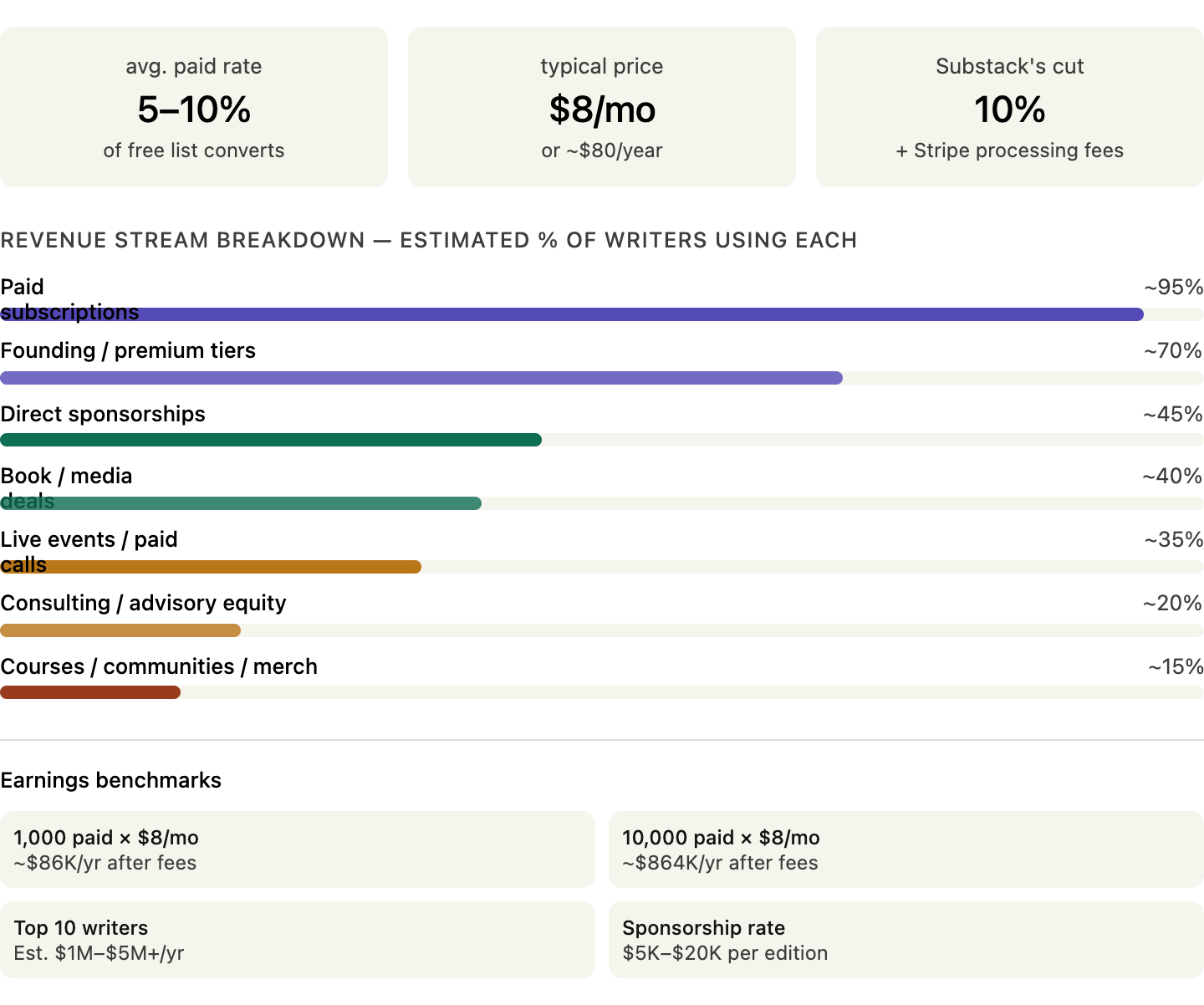
Paid subscriptions are the foundation for most. The standard model is a free tier (to grow audience) plus a paid tier at $5–10/month or $50–100/year. Writers like Heather Cox Richardson reportedly earn $5M+ annually this way alone. The key is high volume — even at $8/month, you need 5,000+ paid subscribers to replace a professional salary.
That model shows up everywhere in the top tier. Lenny’s Newsletter describes itself not just as a newsletter, but as a bundle of “newsletter, podcast, community, and living library.” The Fifth Column pushes paid-only podcast episodes and archives. SemiAnalysis, Citrini Research, and Compounding Quality all sell paid access to premium research. This is the real pattern: readers are not buying posts. They’re buying ongoing access to a valuable stream of insight.
Bundling and “founding member” tiers have become a major upsell. Writers offer $200–500/year “founding” tiers with perks (Discord access, exclusive posts, Q&A calls). This small cohort of superfans often contributes a disproportionate share of total revenue.
Substack explicitly describes founding memberships as a higher-priced option for readers who want to pay more as a show of support. That means top Substacks are not limited to a single subscription price; they can monetize super-fans without inventing some weird duct-taped Patreon tier on the side.
On Substack, status is a product. Founding members are often paying for identity, access, and affiliation as much as for incremental content. Fancy way of saying: people like being the kind of person who backs the thing early and visibly.
Events and live access — paid Substack calls, virtual workshops, or AMAs are increasingly common. Some top writers charge separately for these; others bundle them into founding memberships. Once a Substack has audience trust, it can sell more than access. It can sell attention and gathering power.
Newcomer is the cleanest example. Eric Newcomer has written plainly that events are working, and that the business also wants to keep growing sponsorships, paid subscriptions, and corporate subscriptions. Event sponsor lists on Cerebral Valley posts make it obvious this is not a hobby newsletter with a Stripe button attached. It is a media business with a newsletter at the center. The VC Corner similarly pitches sponsorship opportunities across both the newsletter and LinkedIn.
This is the pivot a lot of top creators make after paid subscriptions start working: first you sell content, then membership, then access to the audience itself.
Book deals and editorial prestige — many top Substackers (Anne Applebaum, Ezra Klein alumni, etc.) use their audience as leverage for book advances or institutional media roles. The Substack itself may not be the primary income; it’s the proof-of-audience.
Consulting and advisory work — finance, tech, and business Substackers (e.g. Mario Gabriele of The Generalist, Packy McCormick of Not Boring) convert their readership into deal flow, advisory equity, or consulting retainers. Some earn more here than from subscriptions.
Sponsorships and ads — Substack officially discourages this and doesn’t have native ad tools, but many writers negotiate their own sponsorships directly, especially those in business, tech, or health niches. A newsletter with 50K+ subscribers can command $5,000–20,000 per sponsored edition.
Merchandise, courses, and communities — more common among lifestyle or creator-adjacent newsletters. Linking out to a paid community (Circle, Discord), a course platform (Maven, Kajabi), or physical merch.
A few patterns that separate the top 100 specifically:
Most of the highest earners treat Substack as a platform rather than their entire business. The newsletter builds trust and audience, then that trust gets monetized through higher-margin channels such as a book deal, a consulting retainer, or a course where Substack isn’t taking a cut.
The niches with the highest ARPU (average revenue per user) tend to be finance, investing, and B2B tech, where readers have professional reasons to pay and the information has clear monetary value. Political and cultural commentary relies more on volume. For example,
Notably, almost none of the top 100 rely on a single stream. The ones pulling in $500K+ per year almost always have at least three: subscriptions + a premium tier + either sponsorships or a secondary product.
They are not charging for words. They’re charging for expertise, belonging, convenience, identity, and leverage. The newsletter is just the delivery vehicle.
What do you think?