
The Most Misunderstood Metric in PLG
Why the 8% free-to-paid conversion benchmark doesn't tell the whole story

Free-to-paid conversion is one of the most misunderstood metrics in PLG. Founders obsess over it. Investors ask about it. Boards benchmark against it.
Yet most people are comparing themselves against a number that tells them almost nothing about the health of their business.
That number? 8%.
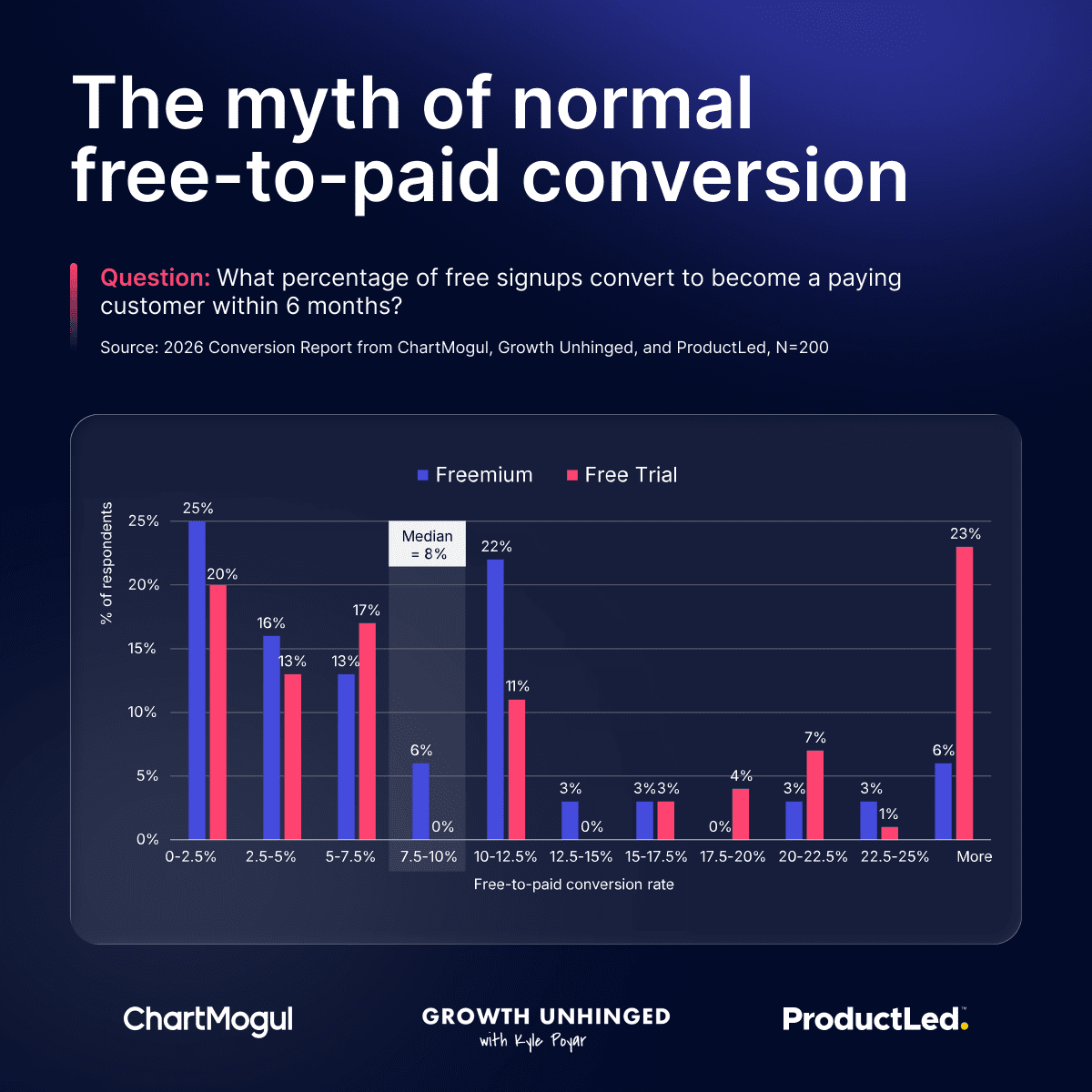
According to the 2026 Conversion Report from ChartMogul, Growth Unhinged, and ProductLed, the median free-to-paid conversion rate is 8%. But when you look at the underlying data, something interesting appears.
Very few companies actually convert at exactly 8%. Most cluster below it. A smaller group dramatically outperform it.
The Myth of “Average”
One of the interesting points from the chart above that caught my attention was that a quarter of freemium products convert less than 2.5% of users.
Another 16% convert between 2.5% and 5%.
That means roughly 40% of freemium companies convert less than 5%.
Yet founders, boards, and investors keep repeating the 8% benchmark.
That’s like saying the average household has 1.9 children. Technically true. Completely useless.
The median creates the illusion of normal. The distribution tells the real story.
What Are You Selling?
The report shows meaningful differences by business model:
Freemium products: 3-5% is considered good (good = 50th percentile)
Free trials: 4-6% is considered good
AI products: 6-8% is considered good
B2B products: 6-10% is considered good
B2B buyers typically arrive with intent because they have a problem that needs to be solved and they know the brand. Consumer buyers often arrive with curiosity and, almost always, intent converts better than curiosity.
The Credit Card Effect Is Wild
The report found that:
Free trials with no credit card convert at 4-6%
Free trials requiring a credit card convert at 25-35%
A credit card requirement can produce conversion rates that are 5x higher because it filters out people who were never serious buyers to begin with. So MQLs might go down, but quality goes way up.
Marketers have spent the last 20 years trying to remove friction from the buyer journey with fewer fields, fewer gates, and no credit card required.
Yet one of the strongest findings in the report is that adding friction can dramatically improve conversion.
The goal is to prevent the wrong users from entering the funnel in the first place.
You're shrinking the top of the funnel in exchange for dramatically improving the quality of people entering it.
Why Founders Keep Getting This Wrong
Most founders obsess over signup volume because more signups feels like growth and if we’re being honest, investors love growth charts. (IYKYK)
Marketing teams love growth charts too, but signups don’t pay salaries, converting customers do. You can optimize for activity, as long as the quality and conversions are increasing along with it.
I see a lot of founders just trying to get people in the door to try their product. The feedback is incredibly valuable in the beginning. However, once you achieve product market fit or fit for one specific use case, you need to start optimizing for conversions.
The Metric I Care About More
If I walked into a PLG company as CMO or CRO, free-to-paid conversion is not the first metric I’m looking at.
I’d want to know:
Revenue per signup
CAC payback
Expansion revenue
Gross retention
Net revenue retention
Because I’ve seen products convert 20% of users and still build a terrible business. I’ve also seen products convert 4% and print money. Conversion rates are a diagnostic metric. Revenue is the outcome metric.
Don’t confuse the two.
What I’d Do Tomorrow
If I were running a PLG or a self-serve motion, I’d:
Audit which acquisition channels produce the highest free-to-paid conversion.
Identify which users activate fastest and become customers.
Add qualification earlier in the journey.
Because the biggest takeaway from this report is that the companies with the best conversion rates are often doing a better job filtering buyers before they ever become users.
The highest conversion rates come from better qualification, not better optimization. Companies often spend months tweaking onboarding flows, activation emails, and pricing pages when the real problem is they're attracting the wrong users in the first place.
What’s your take?
Would you rather have:
10,000 signups converting at 4%
2,000 signups converting at 25%
As a CMO or a CRO, I know which dashboard I’d rather explain to the board.
p.s. if you want to read more about how to increase free-to-paid conversion, read part 2 of Kyle Poyar’s research here.